Subterranean termites require continuous soil moisture and construct pencil-wide shelter tubes composed of soil, saliva, and fecal matter to traverse exposed concrete foundations without desiccating under the desert…
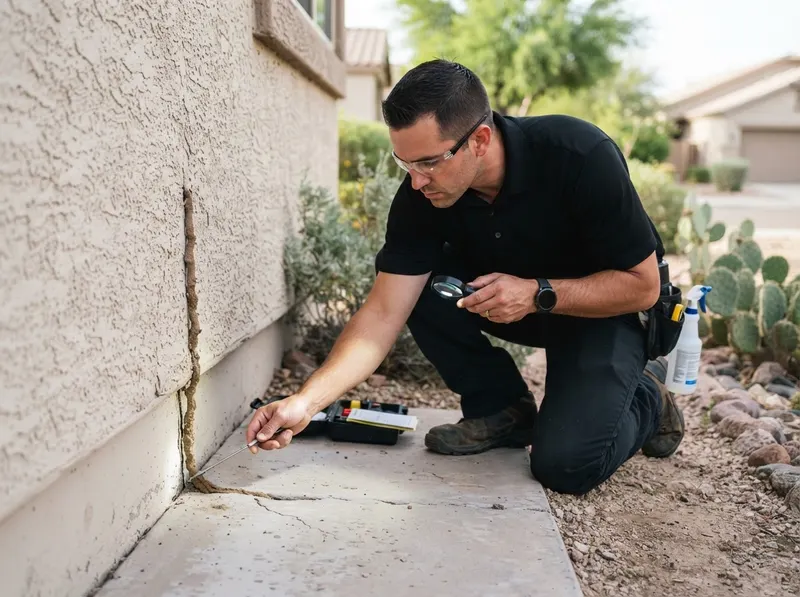
Subterranean termites require continuous soil moisture and construct pencil-wide shelter tubes composed of soil, saliva, and fecal matter to traverse exposed concrete foundations without desiccating under the desert heat. In Gilbert neighborhoods like Val Vista Lakes and The Islands, sustained landscape irrigation creates an ideal moisture gradient that attracts subterranean colonies directly to exterior stem walls. When concrete foundations settle, shrinkage fissures as narrow as 1/32 of an inch, roughly the thickness of a standard business card, provide termites direct subterranean access through the slab into interior drywall studs, sill plates, and baseboards without generating visible exterior mud tubes. A standard visual pest check often misses these internal stress-crack entries until mud tubes break through interior drywall or baseboard trim begins to buckle near high-moisture rooms.
Properties constructed with post-tension slabs throughout master-planned communities like Power Ranch, Seville Golf and Country Club, and Morrison Ranch feature post-pour expansion joints and plumbing block-outs that settle at varying rates. An inspection systematically documents whether mud tubes on stucco screeds are active by breaking a 1/2-inch test section and verifying whether worker termites reconstruct the passage within 48 hours. If active colonies breach an interior expansion joint under engineered hardwood or carpet, localized non-repellent liquid termiticide slab injections fit the scenario without requiring full-property trenching. If evidence reveals mud tubes limited strictly to the perimeter foundation near exterior hose bibbs or air conditioning condensation lines in Coronado Ranch, a non-invasive continuous liquid soil barrier fits best. The primary trade-off balances focused spot drilling through finished interior flooring against broader trench-and-treat exterior perimeters that protect the full perimeter but require digging along gravel and turf edges.
Technicians systematically execute a numbered four-step evaluation on every Gilbert property: 1. Visual identification of all perimeter foundation weep screeds and exterior masonry veneer joints. 2. Acoustic sounding of exposed baseboards, door frames, and interior wall framing beneath bathroom fixtures. 3. Thermal imaging scans along common foundation slab cracks to detect moisture pockets left by subterranean tunneling. 4. Documentation of precise mud-tube locations, termite species classification, and structural risk zones on a comprehensive site schematic for targeted treatment planning.
Every job gets a firm, written price after a free on-site visit.
Tell us about your cracked-slab and mud-tube termite inspections job in Gilbert and we'll send a clear, written quote, usually the same day.
 Saguaro Trail Pest Control