Arizona bark scorpions enter homes through exterior gaps as narrow as 1/16 of an inch, making standard baseboard pest sprays ineffective for long-term protection. Properties bordering greenbelts, citrus groves, or…
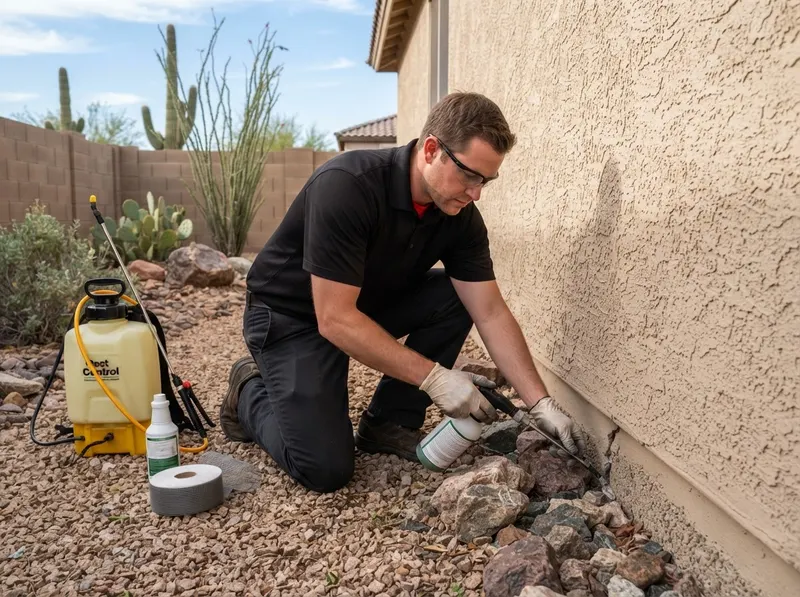
Arizona bark scorpions enter homes through exterior gaps as narrow as 1/16 of an inch, making standard baseboard pest sprays ineffective for long-term protection. Properties bordering greenbelts, citrus groves, or surface water, such as lakefront lots in The Islands, Val Vista Lakes, or agrarian parcels in Agritopia, experience elevated scorpion pressure due to elevated humidity and dense prey insect populations. In communities like Power Ranch, Morrison Ranch, and Seville Golf and Country Club, block wall expansion joints and decorative stone veneer weep screeds serve as primary daytime nesting harborage. Unlike general insects, bark scorpions possess a durable cuticle that resists contact insecticides unless specialized microencapsulated formulations adhere to their bodies while they cross treated perimeters.
Effective management requires separating chemical perimeter barriers from physical home sealing. If a property exhibits heavy exterior scorpion activity on perimeter block walls but clear interior baseboards, a continuous 3-foot ground and 3-foot stem-wall liquid barrier provides sufficient containment. If bark scorpions have already been spotted inside bedrooms, nurseries, or vaulted ceilings, the home requires structural exclusion. Physical exclusion involves securing exterior weep screeds with wire mesh vents, caulking plumbing escutcheon plates beneath sinks, and sealing weatherstripping along exterior thresholds. The trade-off centers on project scope: liquid barrier treatments require renewal every 30 to 60 days during peak summer heat, whereas mechanical structural exclusion involves higher upfront installation costs but physically prevents indoor access regardless of surrounding desert pest cycles.
Local architectural features dictate treatment methods across Gilbert subdivisions. In Coronado Ranch, Finley Farms, and Layton Lakes, expansive clay soils cause concrete flatwork to separate from stem walls over time, opening subterranean migration pathways directly into interior wall voids. Addressing these gaps prevents scorpions from utilizing hollow concrete masonry units (CMU) to scale exterior walls and drop from ceiling vents. Work proceeds in sequential phases: 1. Conduct a daytime structural audit and optional nighttime ultraviolet detection sweep. 2. Mechanically seal open utility entry points and foundation weep screeds. 3. Apply a specialized exterior barrier using microencapsulated compounds that withstand Maricopa County ground temperatures exceeding 140 degrees Fahrenheit. Exact estimates depend on foundation linear footage, with transparent quotes provided during the initial visit.
Every job gets a firm, written price after a free on-site visit.
Tell us about your bark scorpion exclusion and perimeter control job in Gilbert and we'll send a clear, written quote, usually the same day.
 Saguaro Trail Pest Control